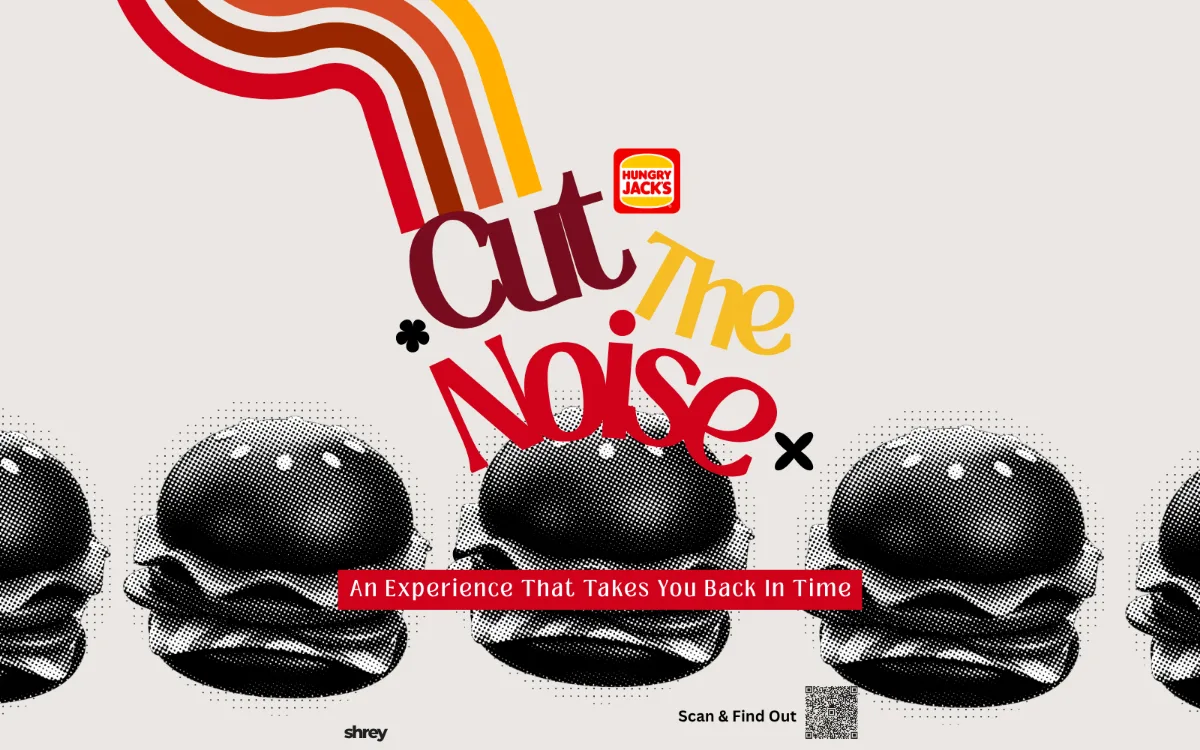
ProblemHungry Jack's is not losing to McDonald's. It's losing to the feed
The product is fine. The food is the same food, the price is competitive, the locations exist. What's gone is the reason to be there. In an era where every QSR has an app, a loyalty point, a scroll-friendly ad and a delivery window, the experience of actually being in a Hungry Jack's has been reduced to a transaction. Fast food has become frictionless food, and frictionless is forgettable.
The brand can't out-content the content. There are not enough impressions in the budget to beat the algorithm at its own game. So the brief became: what if we left the game entirely?
HypothesisRestraint is a campaign
The highest-signal thing a QSR brand can do in a saturated attention market is create an experience worth talking about. Not an ad worth watching. An experience worth describing to someone later.
Anti-content is content. Restraint is a campaign.
The insightPeople are not tired of Hungry Jack's
They are tired of being treated like a session. An order number, a loyalty tier, a retargeting pixel. The moment a brand makes a customer feel like a person in a room rather than a unit in a funnel, the contrast is so sharp it becomes the thing they tell someone about.
Key decisionsThree calls, and what each one cost
Restraint is easy to describe and expensive to choose. These are the three points where it was chosen.
Decision 01Leave the feed instead of competing in it
- Options
- Out-content the category · buy more impressions · leave the game
- Why
- The brand cannot out-content the content, and there are not enough impressions in the budget to win that fight. The highest-signal move left is an experience worth describing to someone later.
- Trade-off
- It trades reach for salience. A one-week format in a handful of stores reaches far fewer people than a media buy, and it only works if those people talk.
Decision 02Spend the heritage the brand actually has
- Options
- Borrow the parent brand’s nostalgia · use Hungry Jack’s own 1985 format
- Why
- The trademark was already taken when the franchise landed in 1971, the name came from a pancake mix, and the local brand outgrew the parent anyway. That is genuinely Australian brand history sitting unused, and the parent brand’s nostalgia was never available here.
- Trade-off
- Heritage only lands with people who already know it, so the execution has to teach the story while it runs, inside a format built on having less to read.
Decision 03Live capture, no actors
- Options
- Script and cast the moment · film the real one and release inside 48 hours
- Why
- The reaction is the content. A performed version of being called by your name proves nothing.
- Trade-off
- The moment cannot be guaranteed, so the shoot runs long and the edit takes what it gets. Releasing inside 48 hours means there is no time to rescue a weak capture.
The ideaRemove what everyone else is adding
Low-Noise Zone
Select stores in major cities run a one-week Low-Noise Zone. Screens dimmed. Ambient sound replaced with natural restaurant noise. Staff trained to use customer names, not numbers.
Cut onions. Cut the noise.
The 1985 Store
Two or three stores restored to the original Hungry Jack's format for one week. No app. No QR code. No loyalty tier. No digital menu board. A printed menu, a counter, and someone who asks your name and then uses it.
Hungry Jack's has an origin story it has never spent. It is the only major QSR in the country that could never use its parent brand's name, the trademark was already taken when the franchise landed in 1971, and it built a bigger local brand than the parent anyway, under a name borrowed from a pancake mix. That is a genuinely Australian piece of brand history, sitting unused.
Cut pickles. Cut the queue.
The Number Script · live capture
Customers called by number. Confusion visible. Frustration mounting. Then the mascot walks in and calls them by their name. Filmed. No script, no actors. The real reaction is the content. Released within 48 hours.
No number. Just your name.
A format, not a headline
The line is built to extend, which is what makes it a platform rather than a single ad. New lines can be written for placements nobody has thought of yet without breaking the system.
- Cut onions. Cut the noise. · master line, Low-Noise Zone
- Cut pickles. Cut the queue. · the 1985 store
- Cut lettuce. Cut the scroll. · the three-second social films
- Cut cheese. Cut the small print. · no app, no QR, no loyalty tier
- Cut tomatoes. Cut the small talk. · transit and OOH
Campaign close, used once: You're more than an order.
ChannelsWhere the budget doesn't go
OOH and transit carry the campaign: static, minimal copy, no QR code. Social gets three-second videos: screen goes black, sound cuts, then the sizzle of a burger and ambient restaurant noise. No voiceover. Paid spend is minimal and only activates behind proven earned content.
ResultWhat would be measured
Spec. Aided brand recall in the target demographic pre and post campaign. Foot traffic differential between activated and non-activated stores. Earned media volume from the live-capture content. Share of organic conversation.
The hypothesis: the Low-Noise Zone generates coverage that a paid media spend of equivalent value could not buy.
LearningThe right question was never how to stand out in the feed
Anti-content is the strategy, not the tactic. The brands winning in earned media are the ones creating moments real enough that people pull out their phones voluntarily, not because they were prompted to, but because the thing they just experienced is worth sharing. That loop is not replicable with ad spend. It has to be earned through the quality of the physical moment.
A brief that asks “how do we stand out in the feed?” is the wrong brief. The right question is: what would make someone look up from it?