ProblemThe wardrobe problem was never volume
People own more clothes than any generation before them and still stand in front of a full closet with nothing to wear. The decision fatigue is real, the waste is compounding, and the apps built to solve it have all made the same mistake: they treat the wardrobe as a management problem rather than an identity one.
You don't need a catalogue. You need a system that understands you well enough to dress you, from what you already own, in a way that actually feels like you.
HypothesisThe AI's job is not to have taste
If an app could catalogue a wardrobe intelligently, not manually, not laboriously, and return outfits that reflect the user's own aesthetic rather than a generic suggested style, it would solve decision fatigue without the implicit insult of telling someone who they should be.
The AI's job is not to have taste. It's to surface yours.
The nameVastr
Vastr comes from the Sanskrit for clothing, ancient, precise, culturally rooted without being exclusive. It plays on vast. The problem is never scarcity, it is that what people own feels unnavigable.
Two names were rejected before this one. Debra wanted to be a voice assistant, warm in the wrong direction for a utility tool. Whear (what to wear) was clever in a room and impossible to spell from hearing; a poor-recall name is a marketing problem baked in on day one. Vastr leaves room to grow beyond any single function.
Key decisionsThree calls, and what each one cost
The reasoning above reads as a straight line because it is written down afterwards. These are the three points where it could have gone another way.
Decision 01Vastr, not Debra or Whear
- Options
- Debra · Whear · Vastr
- Why
- Sanskrit for clothing, and it plays on vast. The problem was never scarcity, it was that what people own feels unnavigable. Debra wanted to be a voice assistant, warm in the wrong direction for a utility tool. Whear was clever in a room and impossible to spell from hearing.
- Trade-off
- Vastr has to be explained once. Debra would never have needed explaining. It would simply have been the wrong promise, every time someone said it out loud.
Decision 02Affiliate that fires on a purchase decision, not on time spent
- Options
- Engagement-driven monetisation · affiliate on a genuine purchase decision
- Why
- Every funded wardrobe app built the same wrong incentive: the product earns when you use it more and buy more, so the interest of the product and the interest of the user are misaligned from day one.
- Trade-off
- Far fewer monetisable moments, and revenue that only arrives once the user has genuinely been served. The model is slower on purpose, which is a harder story to tell an investor than a usage graph.
Decision 03Recognition, not data entry
- Options
- Manual entry · catalogue from a product tag, a description or a photo
- Why
- An outfit engine is only as good as the wardrobe behind it, and a wardrobe nobody maintains returns nothing. Upkeep is the point where this category loses people.
- Trade-off
- Recognition errors land in the catalogue and the engine inherits them. Accuracy stops being the user’s chore and becomes the product’s risk.
The productThree features, one loop
Digital Wardrobe
Catalogue what you own via product tag, description, or photo. Vastr sorts, remembers and surfaces it. No manual upkeep.
Outfit Engine
Input a vibe, an occasion, or a mood. Vastr returns outfits built from what is already in the wardrobe, styled in your visual language, not an influencer's.
The Shop
If something is genuinely missing, the shop finds it. Compare options and buy through the affiliate layer. The product earns only when the user decides to add something. Not when they scroll.
The brandA calm wardrobe on a good morning
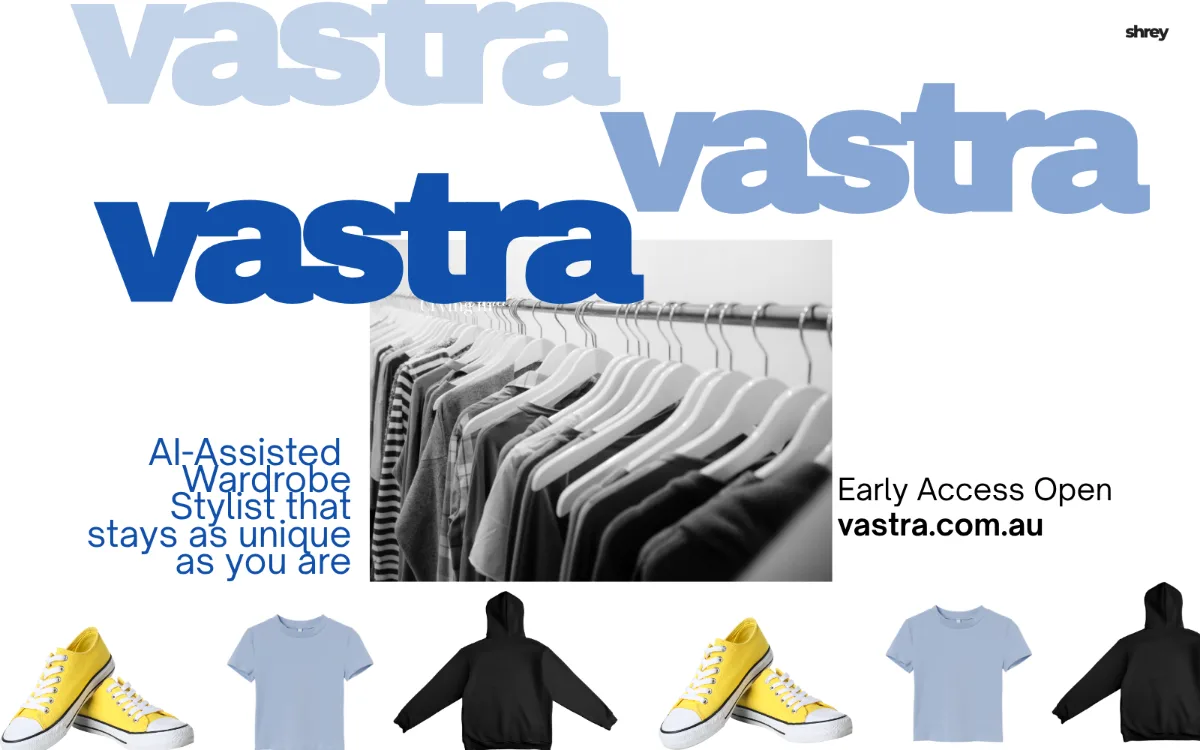
Logotype: the V is a clothing hanger. The crossbar of the letter is the rail, functional, precise, works at any scale from favicon to billboard.
Palette: blue, white, indigo. Not fashion-black, not tech-blue. The visual register of a calm wardrobe on a good morning.
Tone: JARVIS from Iron Man. Functional, precise, occasionally dry. Talks to you like it knows what it is doing and respects that you do too. Never over-explains. If Vastr says “here's your Tuesday,” it means it.
MessagingValue-Based Clothing
Comfort of Choice
The decision is already made. A good one. Without the Sunday-night wardrobe spiral.
Utility & Time-Savvy
Your wardrobe works as hard as you do. Everything you own earns its place or gets surfaced until it does.
Your Style, Big-Time
Not someone else's aesthetic at your scale. Yours, louder.
The launchTeaser, then live
The teaser shows a grey, identical world. Same white tee. Same blue jeans. No variation, no identity, no decision, just a directive carried out. One voice, plain: “I own 47 things and have nothing to wear.” No product. Just the problem, named.
Launch: the same wardrobe. Vastr in it now. Pieces surface. An outfit assembles that is unmistakably that person, not a suggestion, a reflection.
Out with the old. Actually, no. In with the old, better.
GTM briefThe one-page version
Objective. 10,000 app downloads in the first 30 days from 18–30s in Tier 1 and Tier 2 cities. A 5,000-strong waitlist before launch day. Affiliate click-through above 8% within 60 days of the shop going live.
Audience. 18–30, style-aware, time-poor, decision-fatigued. They own more than they wear. They would dress better if they could find what they already have.
Positioning. For people who want to dress intentionally without the cognitive load, Vastr is the AI wardrobe companion that catalogues what you own and builds outfits that feel like you, unlike Whering, Indyx, Acloset, Save Your Wardrobe and Stylebook, which require manual effort without intelligent output.
Revenue. Affiliate pricing on shop purchases. The product earns when the user chooses to buy something they genuinely need, not on subscription, not on scroll volume.
Channels. TikTok for transformation content and creator seeding · Instagram for visual identity and waitlist Stories · App Store and Play Store keyword SEO · PR on the sustainability and AI angle · email for waitlist nurture and post-download onboarding.
Read the PRD →Scope, requirements, success metrics and the kill criterion. The document behind this page.
ResultNo numbers, because there are none
Spec, so there are no post-launch numbers, and no invented ones. What would be measured: downloads at day 7 and day 30, wardrobe entries per user, outfit acceptance rate, day-30 return rate, affiliate click-through.
A 65%+ acceptance rate is the signal that the AI is reflecting the user's taste rather than guessing at it. That is the only number that would tell you whether the hypothesis held.
LearningEvery funded wardrobe app built the same wrong incentive
The product earns when you use it more and buy more, which means the interest of the product and the interest of the user are misaligned from day one. Vastr's affiliate model fires only on a genuine purchase decision. The product has to earn the moment someone decides they are missing something, not manufacture that moment.
The second thing building this revealed: AI in fashion has been positioned almost entirely around trend and recommendation: what you should want next. The more useful question, and the less crowded space, is what you already have and what you can do with it. Sustainability as a byproduct of utility is a stronger position than sustainability as a brief.